Random House Came Knocking – Then They Asked For $3,200
I almost published the news on this blog.
The Final Cross had been out a short while when the email came in. Penguin Random House. A scout who’d read the book, liked the book, wanted to talk about the book. I read it twice, then read it to my wife. I told my kids. I started drafting the announcement post in my head — the one where the indie guy from Upcountry Maui gets the call.
The scout said I’d hear from a preferred agent. I did, within a day, and the agent gushed all over me. Voice, pacing, the Stilley character, the series potential. Then came the ask.
A $3,200 manuscript review fee, and we’d be on our way.
I hit the brakes. Not because I’m smarter than anyone else, but because I spent a previous career in securities and commercial real estate, and I know what it sounds like when someone builds enthusiasm right up to the moment they need your bank details. When I confronted them, they vanished. My wife and kids were kind enough not to make me eat my words.
Here’s the part that still bothers me: the identity they used belonged to a real Random House employee. The email signature was accurate. If you’d asked me to spot the fake by looking, I’m not sure I could have.
This is not a rare event. It’s a daily one.
I get at least a half dozen of these a day. Editors at major imprints, top-tier agencies, news anchors, bestselling authors. Below are three real ones from my own archive, six months apart, and what gives each away.
March 2026: Penguin Random House
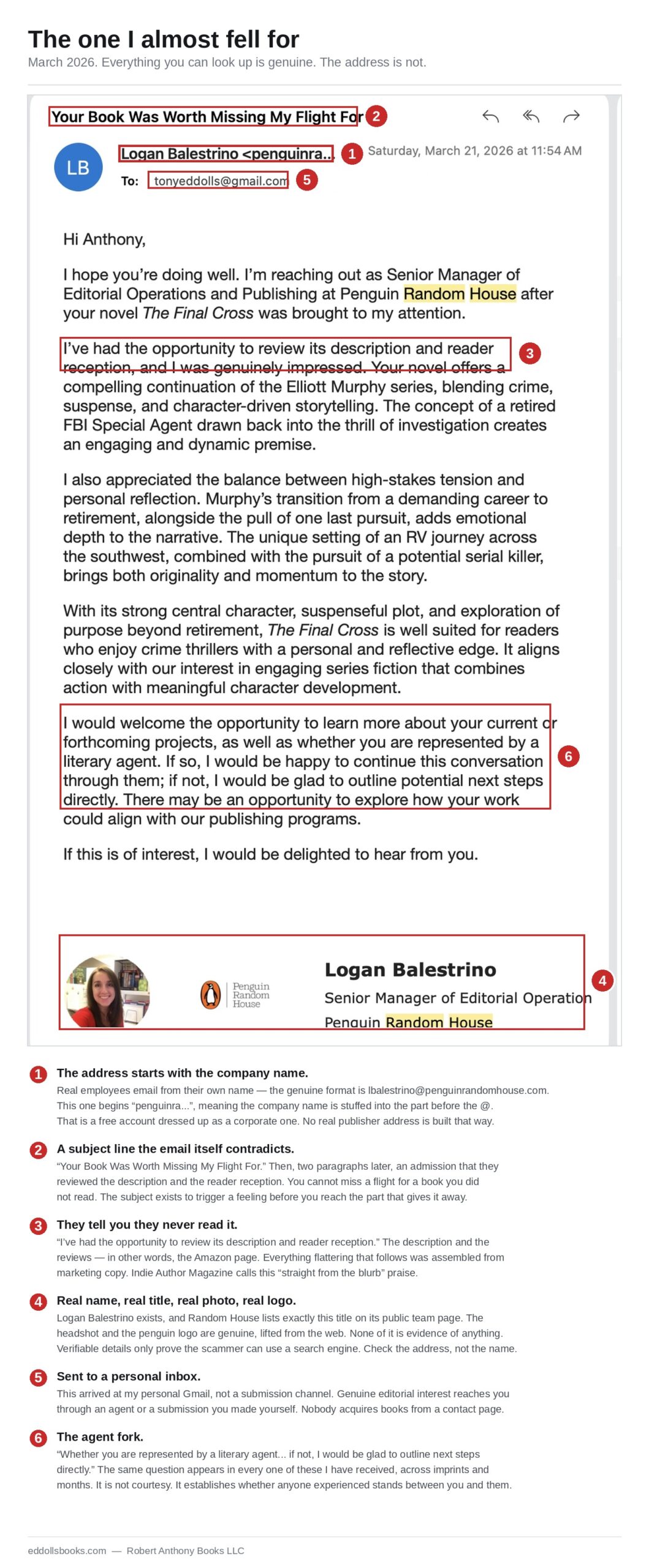
Annotated email impersonating Random House employee
This is the one that got me, and I want to be honest about how far it got: roughly a dozen messages back and forth before the fee showed up.
Everything you could look up in it was genuine. Logan Balestrino is a real Random House employee. The title in the signature is exactly what Random House lists on its own team page. The headshot was her real headshot. The penguin logo was the real logo. If you tried to verify the person, you would have concluded it was legitimate — I did.
The address is what gives it away, and only the address. A real publishing employee emails you from their own name; the genuine format here would be [email protected]. The one that reached me begins “penguinra” before the @ — the company name stuffed into the username of an account that isn’t theirs. No publisher on earth issues addresses that way.
Two more things I missed at the time. The subject line was “Your Book Was Worth Missing My Flight For” — and two paragraphs later the same email admits they “had the opportunity to review its description and reader reception.” The description and the reviews. My Amazon page. You cannot miss a flight for a book you never opened, and every flattering observation in it was assembled from marketing copy. Indie Author Magazine calls this “straight from the blurb” praise, and it’s the signature of the AI era: fluent, specific-sounding, sourced entirely from a product listing.
It also arrived at my personal Gmail. Not a submission, not through an agent. Nobody acquires books from a contact page.
September 2026: Penguin Random House again
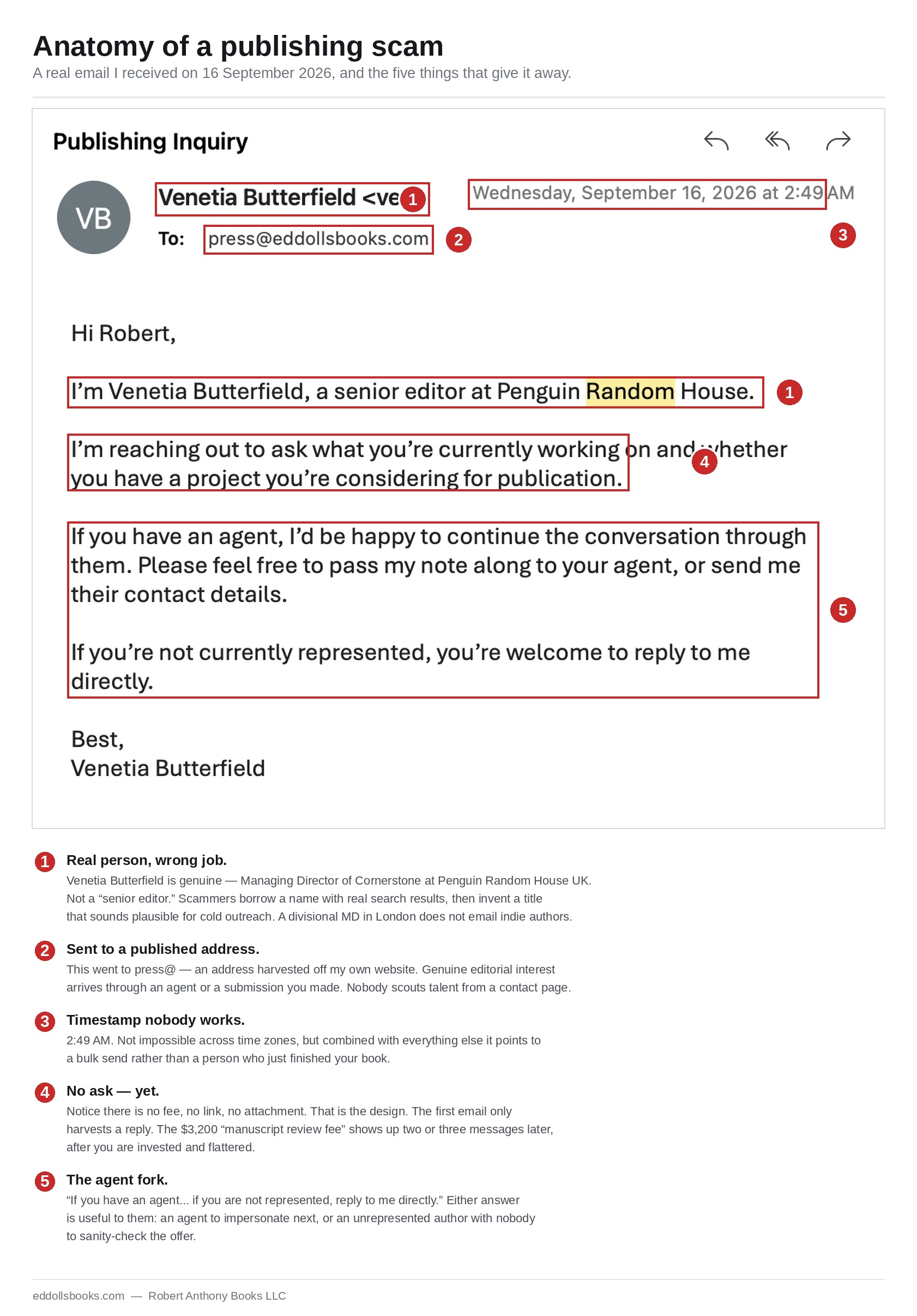
Six months later, same house, different persona. Sent at 2:49 AM to an address harvested off my contact page.
Annotated scam email impersonating a Penguin Random House managing director
Six months later, same house, new persona. Venetia Butterfield is also real — she’s Managing Director of Cornerstone at Penguin Random House UK, not a “senior editor.” A divisional managing director in London does not cold-email American indie authors at 2:49 in the morning to ask what they’re working on. And note where it landed: press@, an address harvested straight off my own contact page.
Notice also what this email doesn’t do. No fee, no link, no attachment. That’s deliberate. The first message only has to earn a reply. The ask arrives two or three messages later, once you’re invested.
‘
HarperCollins, same playbook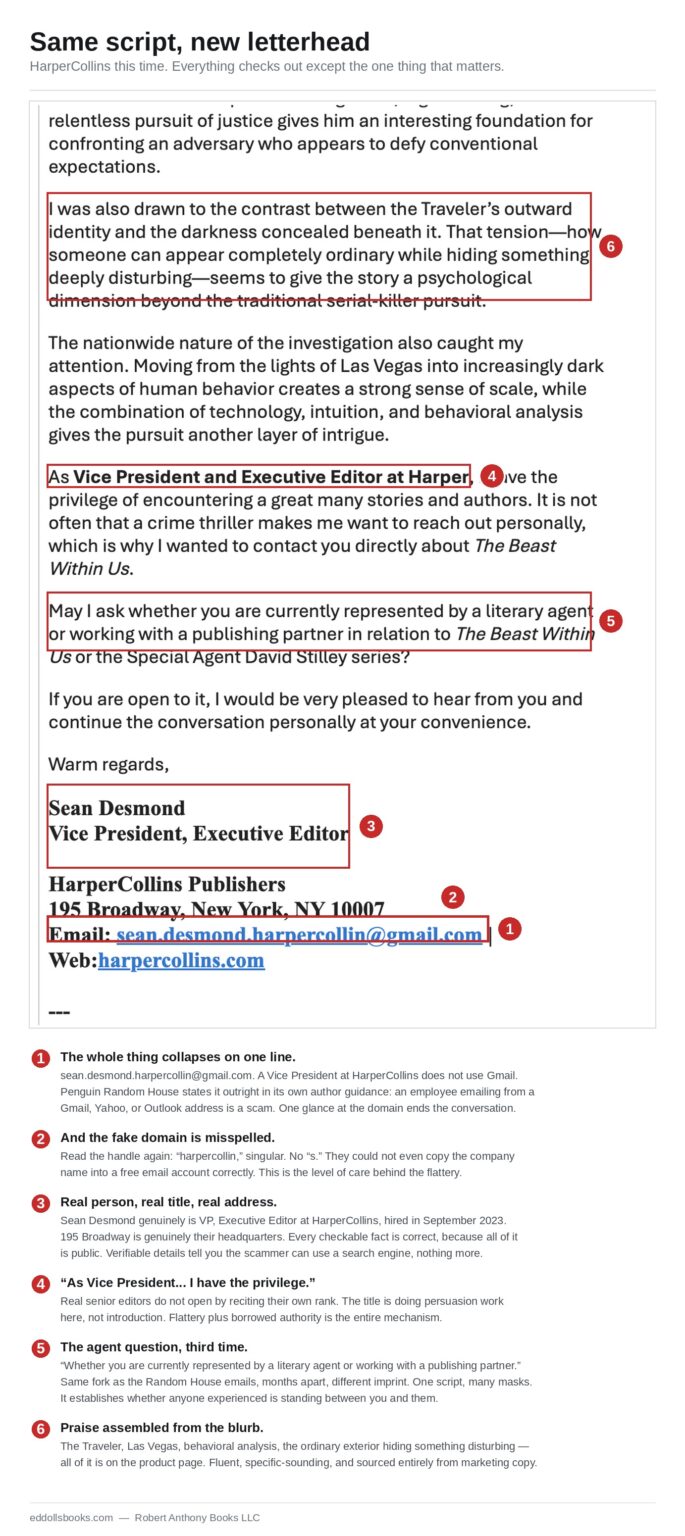
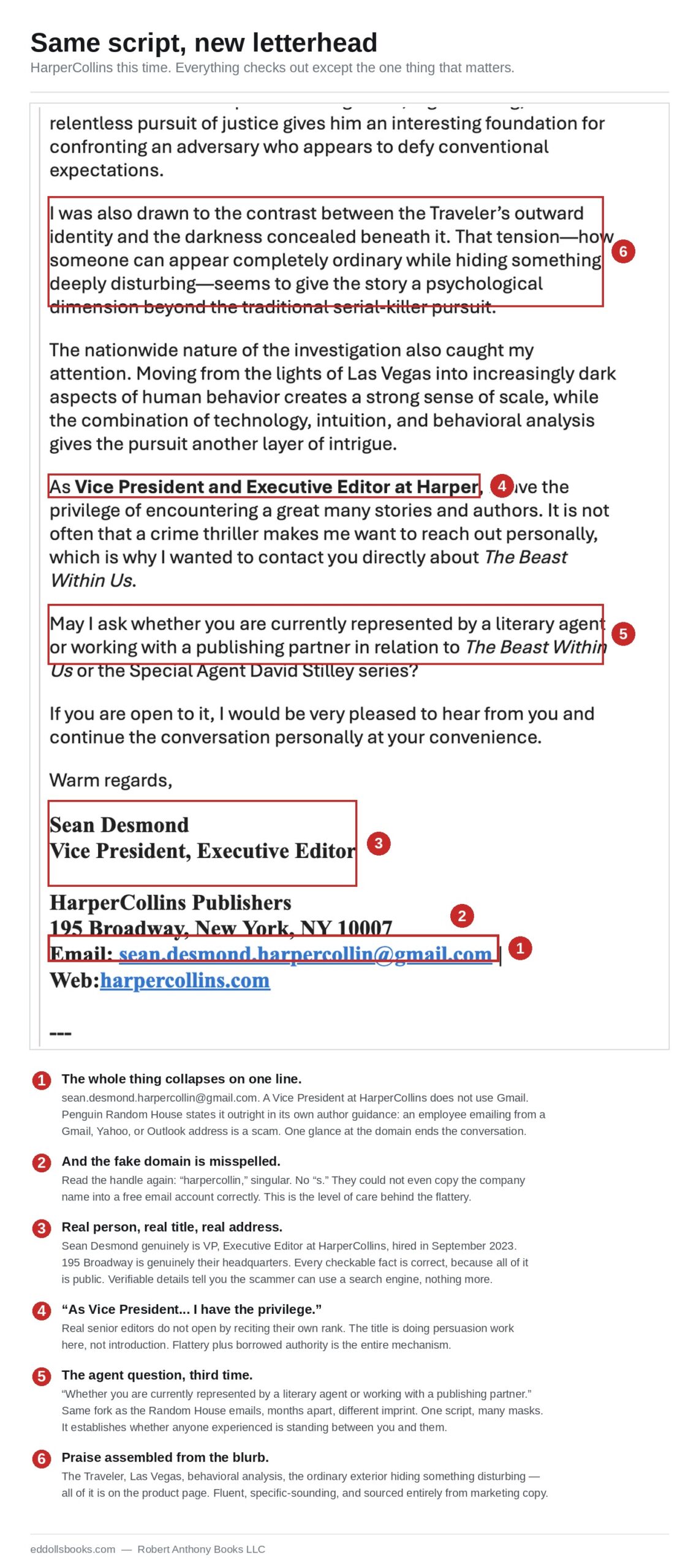
Annotated scam email impersonating a HarperCollins vice president
Sean Desmond is real — genuinely VP, Executive Editor at HarperCollins since 2023. 195 Broadway is genuinely their headquarters. And then:
A HarperCollins vice president does not use Gmail. Penguin Random House says it flatly in its own author guidance: an employee emailing you from a Gmail, Yahoo, or Outlook address is a scam. The Authors Guild lists free email domains as a primary indicator. And look closer at the handle — “harpercollin,” singular. They couldn’t even correctly copy the company name into a free email account.
That’s the quick reveal. A fake Gmail address takes ten seconds to create and any name will fit in front of it, which is exactly why the domain is the one thing a scammer cannot fake. Check it before you read a word of the flattery.
The pattern across all three
Different imprints, different personas, months apart — and the same fork in every one: Are you represented by an agent? If so, pass this to them. If not, reply to me directly. One script, many masks. That question isn’t courtesy. It’s finding out whether anyone experienced is standing between you and them.
None of this is a secret in the watchdog world. Writer Beware maintains an impersonation list covering scammers posing as writers, agents, editors, book festivals, and radio hosts, and in March 2026 they flagged a scam specifically impersonating editors at major publishing houses. Penguin Random House maintains a dedicated Combatting Fraud page confirming that scammers impersonate its employees and specifically target self-published authors. Hachette has one too, stating plainly that they never charge a fee to review a manuscript.
When this many major houses have to publish pages telling authors their own employees don’t work this way, you understand the scale.
Writer Beware’s guidance is blunt, and it’s the most useful sentence I’ve read on the subject: any publishing or film-rights contact you can’t trace to a submission you made should be assumed fraudulent until proven otherwise.
That inverts the instinct. The exciting email isn’t an opportunity to verify. It’s a scam until it isn’t.
Why they come after us specifically
I’ve thought a lot about the rationale, and it’s uglier than simple opportunism.
Indie authors are a vulnerable population because we’re desperate. Desperate for the big break, desperate for a larger audience, desperate to just be recognized. That’s not a criticism of anyone in this community, myself included. It’s the condition of doing creative work without a gatekeeper’s validation. And it’s precisely the pressure point these people press.
We’re also isolated. This is a lonely, vulnerable place to work. We have few advocates and even fewer reliable sources of honest guidance, so there’s often nobody to run the too-good-to-be-true email past. A traditionally published author has an agent who’d laugh at a $3,200 review fee. Most of us don’t have anyone.
I can absorb a hit. I’ve taken plenty — the claims I bought early on around advertising, marketing assets, editing, all of it, sold by vendors who never delivered. Many indie authors can’t. They’re the starving artists of the stereotype, and they’re exactly who these pitches are built for.
Think about who’s actually being targeted here. Independent artists, sacrificing time and money to entertain and move an audience. Not wealthy investors. Not tycoons. People writing books in the hours around a day job. Going after them is disgusting.
What I check now, every time
A short list, learned the hard way.
Check the domain first, before anything else. Not the display name, not the signature — the actual address, character by character. Gmail, Yahoo, or Outlook ends it immediately. So does a corporate domain that’s one letter off, or plural where it should be singular. This is a five-second check that defeats most of them, and doing it first means the flattery never gets a chance to work on you.
Did I initiate contact? If I didn’t submit to them, the burden of proof is entirely theirs.
Is there a fee? Any fee. Legitimate agents earn a commission on sales they make for you. Reading fees and manuscript review fees are a warning sign by definition — money that’s due before any service has been rendered.
Can I verify the person independently? Look them up on the publisher’s own site, then contact them through that channel — never by replying. And check the role, not just the name. Editorial operations manages schedules and production workflow; nobody in that seat acquires manuscripts. All three of my emails used real people. The name checking out means nothing.
Is the enthusiasm doing work? Real editorial interest is specific and fairly measured. Scam praise is lavish, vague, and arrives suspiciously fast. It’s manufacturing urgency so you don’t stop to check.
Have I told one other person? Not for validation — to break the isolation the scam depends on. My near-miss ended because I said the number out loud.
Why I’m writing this down
This is another aspect of our niche that doesn’t get the attention it deserves. We don’t talk about it. We absorb it, feel slightly stupid for having hoped, and move on.
The scams are relentless, brazen, largely untraceable, and almost never prosecuted, so they aren’t going away. The only real defense is that more of us say out loud what happened to us, so the next author recognizes the pattern in the first email rather than the third.
So: Penguin Random House came knocking, and I fell for it for about thirty-six hours. If that saves you $3,200, it was worth admitting.
And yes — some part of me still hopes that maybe, just maybe, next time it really is Random House.
If you’ve been approached and want to check it out, Writer Beware and the Authors Guild scam alerts page are the two resources I’d point anyone to first. Both are free, and both are run by people with no product to sell you.